What is a boutique hotel?
A boutique hotel is a small, usually independent property that stands out for a distinctive design, personal service and a close connection to its neighborhood. There is no legal definition and no fixed room count, but the most widely used benchmark is fewer than 100 rooms. What sets it apart is scale and character, not price or star rating.
The word says it all: like a small shop next to a department store, a boutique hotel bets on curation and detail rather than volume. Two properties can charge the same nightly rate and feel completely different; the boutique one is the place whose staff remembers how you take your coffee.
Where the term comes from
The idea took shape between the late 1970s and the early 1980s. Three properties are usually credited as pioneers:
- Blakes Hotel in London, opened by designer Anouska Hempel in 1978.
- The Clarion Bedford Hotel in San Francisco, opened by Bill Kimpton in 1981.
- Morgans Hotel in New York, opened in 1984 by Ian Schrager and Steve Rubell, with interiors by Andrée Putman.
Rubell is credited with coining the phrase when he compared Morgans to a boutique rather than a department store: an independent hotel set against the big chains.
Is "boutique" an official hotel category in Colombia?
No. Colombia's hotel star-rating standard, NTSH 006 (last revised in 2009 and now considered outdated by the Ministry of Commerce, Industry and Tourism), has no "boutique" category. Any property can use the word, so look at what sits behind the label. What is mandatory for every tourist accommodation is registration in the National Tourism Registry, known by its Spanish initials RNT.
What are the key traits of a boutique hotel?
You can spot a real boutique hotel by five traits that almost always travel together: few rooms, design with a sense of place, personal service, food and drink with its own identity, and a location in a neighborhood with everyday life. If a property is missing two or three of these, "boutique" is probably more marketing than substance.
- Small scale. With fewer rooms, the team can recognize you, remember your preferences and fix things without layers of approvals.
- Design rooted in place. Local materials, art or crafts instead of a generic look that could be anywhere in the world.
- Personal service. Tips from people who actually live in the city, help arranging tours or airport transfers, and conversations that don't follow a script.
- Food with personality. A café, restaurant or rooftop that locals also go to, not just a hotel dining room.
- A neighborhood worth walking. Parks, cafés and residents around you, rather than a zone built only for visitors.
Boutique hotel vs. chain hotel: which fits your trip?
The main difference is scale and who makes the decisions. A chain hotel repeats its brand standards in city after city, which gives you predictability; a boutique hotel shapes its design, service and food around its own location, which gives you character. Neither is better in the abstract; it comes down to what you want from this particular trip.
| What to compare | Boutique hotel | Chain hotel |
|---|---|---|
| Size | Few rooms; the usual benchmark is under 100 | From dozens to hundreds of rooms |
| Design | One of a kind, tied to the place | Brand standard, similar everywhere |
| Service | Personal and flexible | Defined, consistent procedures |
| Food and drink | Cafés or restaurants with their own identity | In-house restaurant and bar |
| Groups and events | Limited by size | Meeting rooms and large-group logistics |
| Loyalty points | Rare | Standard with the big brands |
| Neighborhood life | Central to the experience | Depends on the location |
If you usually stay with a big brand to collect points, weigh that against what a local, small-scale stay gives you in a city like Medellín, where the neighborhood you pick shapes most of your trip.
Is a boutique hotel the same as a luxury hotel?
No. A luxury hotel is defined by the level of its services and facilities, while a boutique hotel is defined by its size and personality. Some boutique hotels are very high-end and others are mid-range, and some luxury hotels have hundreds of rooms. "Boutique" describes how the stay feels, not how much it costs.
Boutique hotel, aparthotel or boutique hostel?
The labels overlap. An aparthotel offers units with kitchens under a single management, and a boutique hotel can also have apartment-style suites. A boutique hostel usually pairs thoughtful design with shared dorms or simpler rooms and a tighter budget. If you are torn between formats, read our comparison of aparthotels, hotels and apartments in Medellín.
How do you choose a boutique hotel in Medellín?
Start with the neighborhood, then check what the rate really includes. Make sure the property has an RNT number, look at real photos of the rooms, read recent reviews and ask about breakfast, kitchens and work space. That way you compare concrete experiences instead of the adjectives in a listing.
- Pick the neighborhood first. Decide whether you want to be close to the nightlife or in a leafy, residential area you can explore on foot; our guide on how to choose a hotel in Medellín walks through the criteria that matter most.
- Check the RNT. Ask for the property's registration number and look it up on the official RNT portal. It is a quick way to avoid unregistered rentals.
- Read the fine print on the rate. Breakfast, parking, internet and taxes can change the final cost a lot.
- Look at the room itself. Square meters, bed size, a kitchen and a balcony make a real difference on stays longer than three nights.
- Read recent reviews. Look for patterns about service, noise and cleanliness rather than one-off comments.
- Contact the hotel directly. A quick message answers questions a booking platform can't; here is why it pays to book direct with the hotel.
A real example in Medellín: Living by Armóniko
Living by Armóniko is a boutique hotel with 14 apartment-style suites right across from Segundo Parque de Laureles in Medellín. Every suite has an equipped kitchen and a private balcony, an à la carte breakfast is included, and the building houses four places to eat and drink, from a specialty café to a Peruvian rooftop.
Laureles belongs to Comuna 11, Laureles-Estadio. Its original layout, credited to engineer and architect Pedro Nel Gómez, set circular streets around parks and the Universidad Pontificia Bolivariana, a radial pattern unlike the grid in the rest of the city. Today the area around Primer Parque and Segundo Parque de Laureles is a busy dining hub.
Suites designed for real living
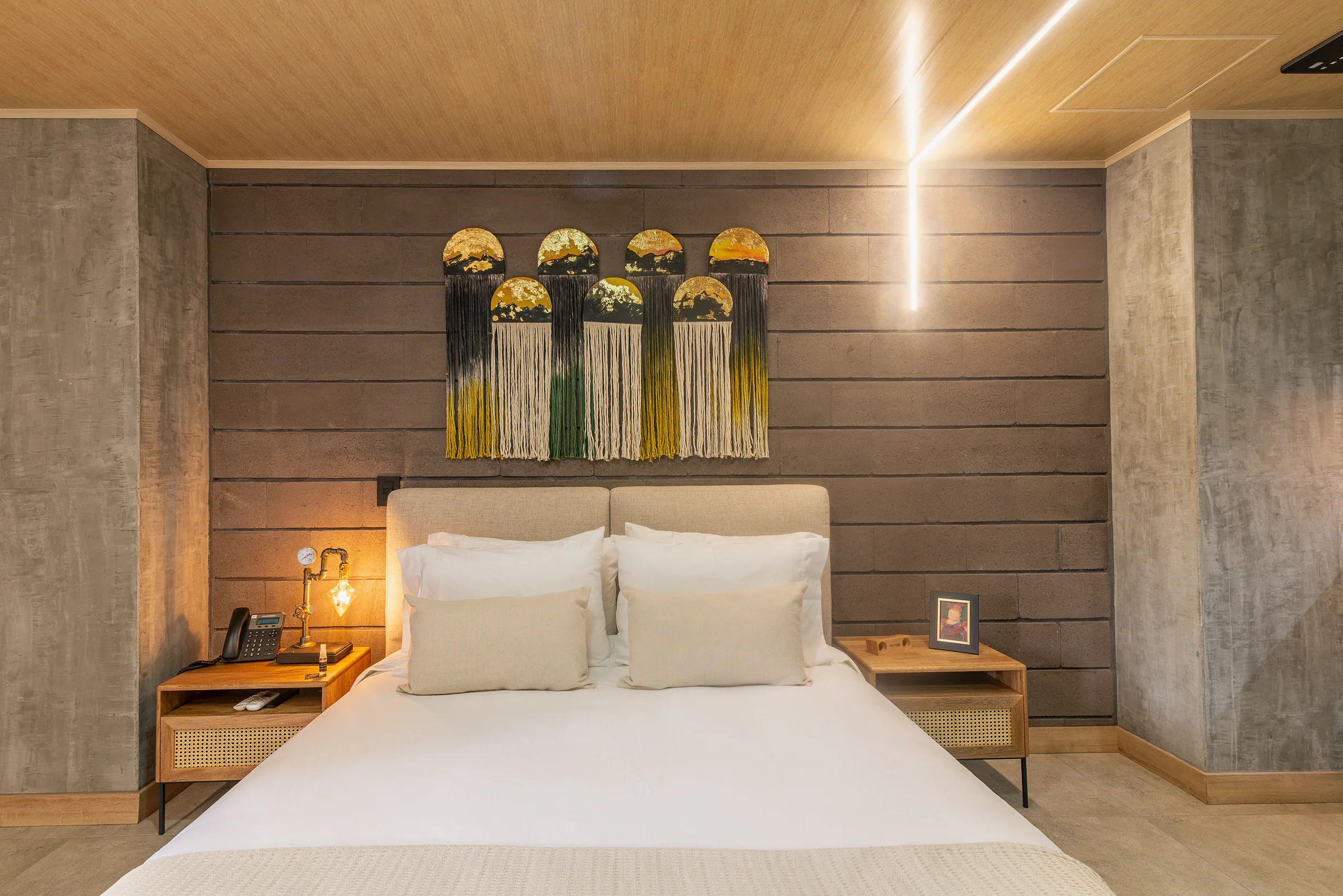
The apartment-style suites with kitchens in Laureles come in four styles: Deluxe (62 m², King bed and a separate living room), Superior (32 m²), Comfort (27 m²) and Standard (20 m²), the last three with a Queen bed. The design leans on natural light and local materials, with touches such as the handmade macramé and organic textures of the Superior Suite.
Four places to eat and drink under one roof
Botswana Café Bar (2nd floor) serves the included à la carte breakfast until 10 a.m.; Rocoto Rooftop (5th floor) pairs Peruvian food with signature cocktails; 123 Wok (1st floor) does contemporary Asian cooking; and Torrealta (2nd floor) is a craft brewery with pizzas and tapas. Guests get 10% off the menu at 123 Wok and at Torrealta (from 3 p.m.). See all the restaurants and services inside the hotel.
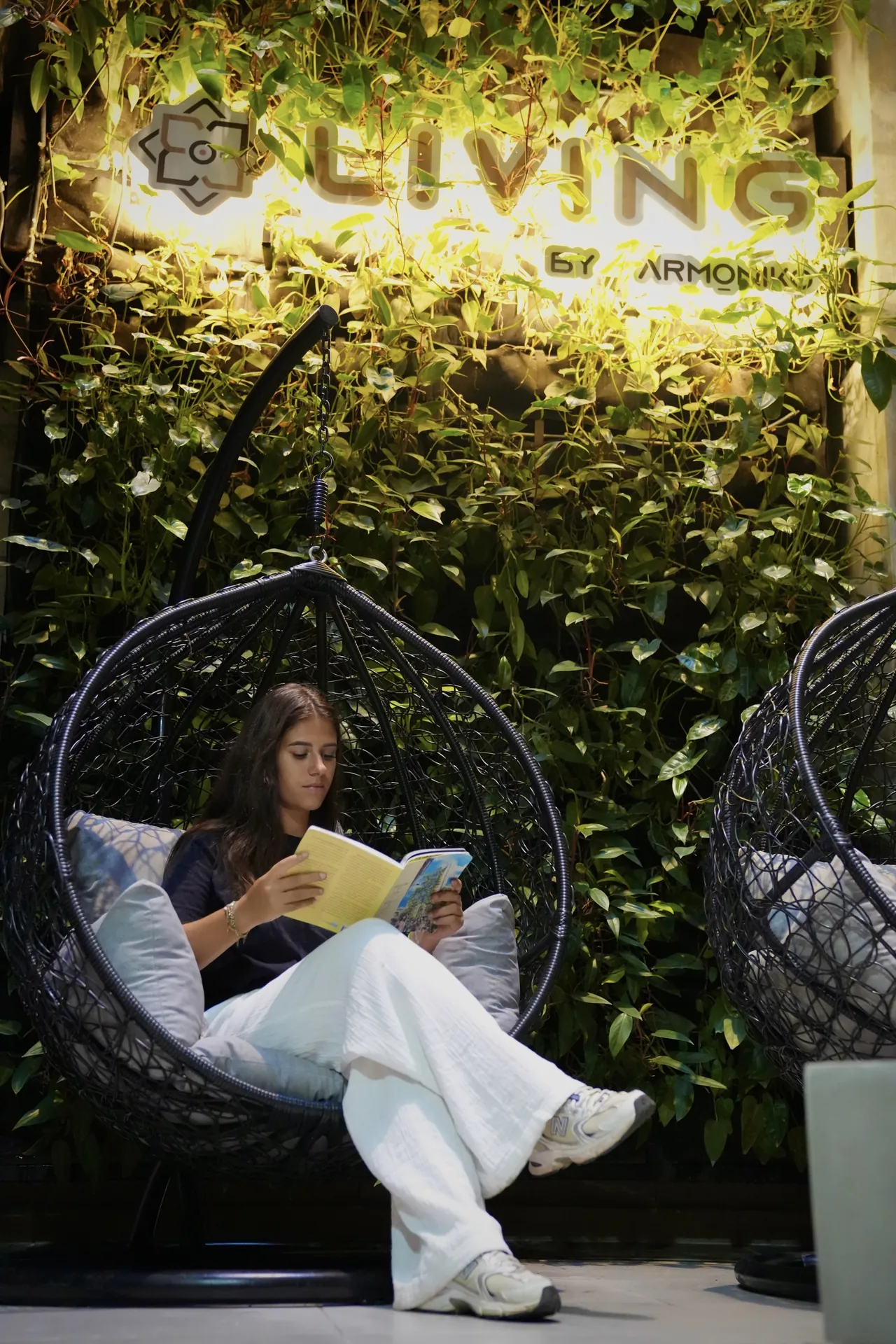
The small scale shows in the service too: a coworking space with high-speed WiFi, a vertical parking system, luggage storage before check-in and after check-out, airport transfers arranged on prior request, and 16 tours coordinated from the front desk. This boutique hotel in Laureles was born during the pandemic as a Medellín family's idea, and it deliberately kept to just 14 suites so the service could stay personal.