Which Colombian fruits should you try first in Medellín?
Start with five fruits that are easy to find and easy to eat: lulo, soursop (guanábana), sweet granadilla, golden berry (uchuva) and yellow dragon fruit (pitahaya). Then move on to the more unusual ones: chontaduro, curuba, tree tomato, gulupa and borojó. All of them turn up in Medellín's produce markets, and many in fresh juices at any café.
Medellín's official tourism guide points out that Colombia is the second most biodiverse country in the world and that fruit is available practically all year round, from sweet to sour. The hotel's Fruit Tour page puts the number of native fruits in the country at over 400.
Sweet fruits you can eat on the spot
- Granadilla: crack the shell with your fingers and slurp the jelly-like pulp, seeds and all.
- Uchuva (golden berry): a small orange berry wrapped in a papery husk, sweet and tangy.
- Yellow pitahaya: spiky yellow skin, sweet white flesh dotted with black seeds.
- Mangosteen (mangostino): native to Southeast Asia but grown in Colombia; an inedible purple rind hiding sweet-and-sour white segments.
Tart fruits made for juice
- Lulo: one of the most Colombian flavors on any juice menu; sour, fresh and green inside.
- Maracuyá and gulupa: two forms of the same passion fruit species, one yellow and one purple.
- Tree tomato and curuba: Andean fruits that usually end up in a glass.
- Borojó: dense and acidic, from the Chocó region on the Pacific side of Colombia.
The wild card: chontaduro
Chontaduro, or peach palm fruit, is nothing like the others. It is starchy rather than sweet: its texture has been compared to a firm sweet potato and its flavor to roasted chestnut. It is always eaten cooked, usually with salt and honey. A classic in Cali and on the Pacific coast, it is also sold in Medellín and is one of the fruits on the Fruit Tour.
Quick guide: how to spot each fruit and how to eat it
To shop with confidence, you need three things about each fruit: what it looks like, how it tastes, and whether you eat it fresh, cooked or as juice. This table sums up the twelve fruits most worth trying in Medellín, including the English name when there is one.
| Fruit | How to spot it | Taste | How to eat it |
|---|---|---|---|
| Lulo (naranjilla) | Round, yellow-orange, covered in fine fuzz | Sour and refreshing | As juice or lulada |
| Guanábana (soursop) | Large, dark green, soft spines | Sweet, creamy, very aromatic | Juice, smoothie or with a spoon |
| Granadilla (sweet granadilla) | Smooth, thin, brittle shell | Sweet and fragrant | Fresh, seeds included |
| Maracuyá (passion fruit) | Round and yellow | Very tart and aromatic | Juice, desserts, sauces |
| Gulupa (purple passion fruit) | The purple form of maracuyá | Similar to passion fruit | Fresh or as juice |
| Uchuva (golden berry) | Orange berry inside a papery husk | Sweet and tangy | Fresh, in salads or desserts |
| Pitahaya (yellow dragon fruit) | Oval, yellow, spiky | Sweet; white flesh, black seeds | Cut in half, eat with a spoon |
| Chontaduro (peach palm) | Red or orange palm fruit | Starchy, not sweet | Always cooked, with salt and honey |
| Tomate de árbol (tamarillo) | Egg-shaped, smooth red or orange skin | Somewhat tart | As juice or sorbet |
| Curuba (banana passion fruit) | Long, yellow, soft skin | Aromatic, passion fruit family | Juice, often blended with milk |
| Borojó | Round, turns from green to brown | Acidic and dense | As juice |
| Mangostino (mangosteen) | Thick purple rind you don't eat | Sweet, tangy, citrusy | Open the rind, eat the segments |
You will also spot mamoncillo (Spanish lime), Andean blackberries, tamarind, papaya, mango and bananas at the stalls. Colombia is among the leading producers of golden berries and yellow dragon fruit, so both are easy to find fresh in Medellín.
Where can you buy fresh fruit in Medellín?
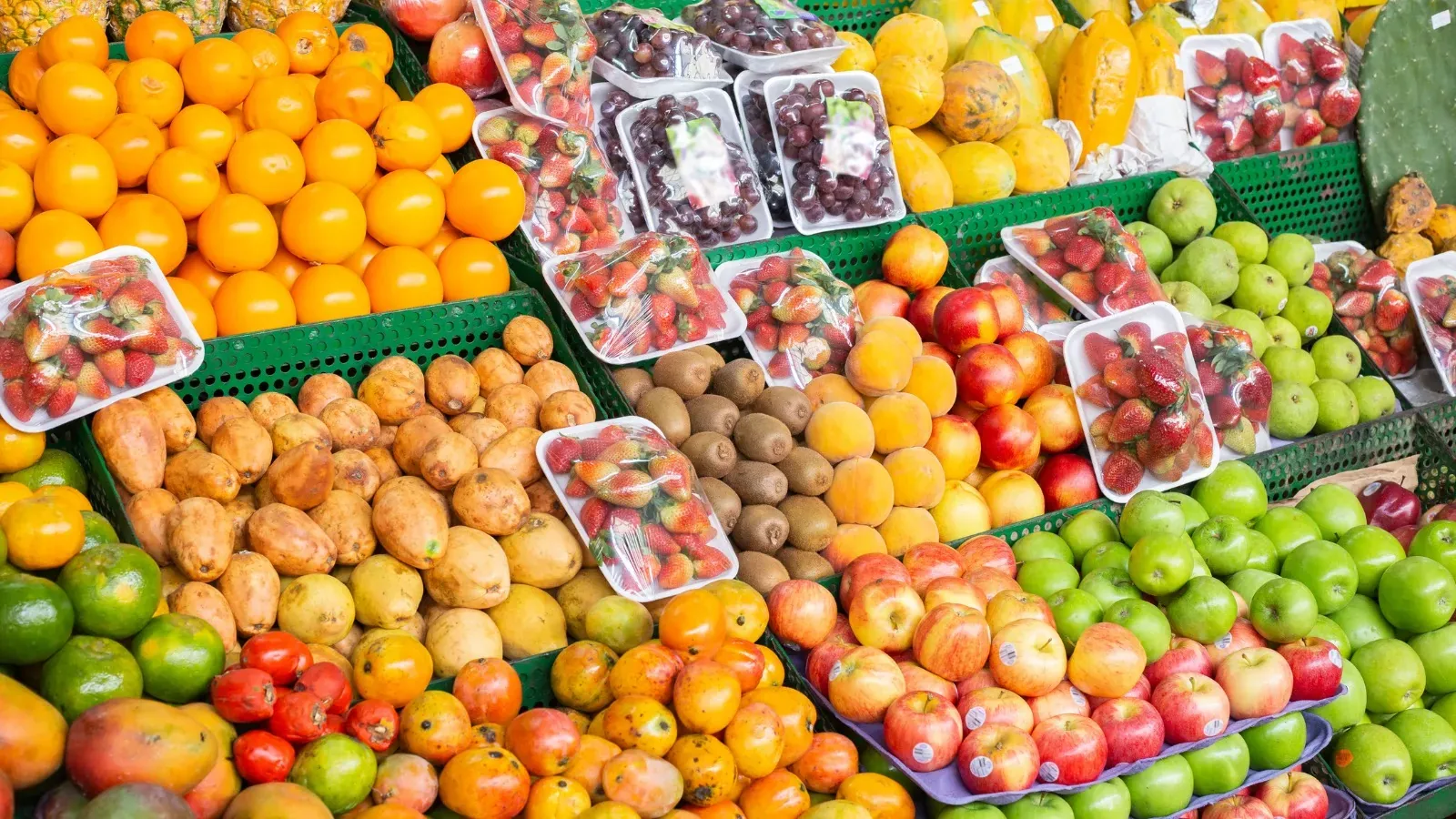
The best places to buy and taste fruit in Medellín are its produce markets: Plaza Minorista José María Villa downtown, Placita de Flórez, considered Colombia's first covered market, and the smaller Plaza de la América on the west side. In neighborhoods like Laureles, you will also see fruit vendors selling from street carts.
Plaza Minorista José María Villa
This is the big downtown market: two floors packed with fruit, vegetables, grains and groceries. According to the official Medellín tourism guide, visitors describe it as clean and safe. Go here to see the full range in one visit.
Placita de Flórez
Placita de Flórez comes with history: it is considered Colombia's first covered market and has been declared a Site of Cultural Interest of Medellín.
Plaza de la América and farmers' markets
Plaza de la América is a much smaller market in the La América district, which borders Laureles-Estadio. According to Medellín's official tourism guide, farmers' markets (mercados campesinos) also pop up in city parks on weekends; check the current schedule before you go.
Fruit carts in Laureles
You don't always need a market. Time Out named Laureles the coolest neighborhood in the world in 2023, and fruit vendors with their street carts are part of everyday life here. Our guide to things to do in Laureles shows how to fit that stop into a morning on foot.
What does the Fruit Tour booked through the hotel include?
The Fruit Tour arranged by the Living by Armóniko front desk lasts 3 hours, from 10:00 a.m. to 1:00 p.m., and takes you through a local produce market to taste regional fruits such as lulo, soursop and chontaduro. It includes round-trip transportation, a bilingual professional guide, travel insurance, a fruit tasting and fresh juice.
A guide takes out the guesswork, which helps if your Spanish is limited: someone explains each fruit and helps you talk to vendors. What is included:
- Travel insurance.
- Bilingual professional guide.
- Round-trip transportation.
- Tour of a local produce market.
- Regional fruit tasting.
- Fresh juice.
See the full Fruit Tour details and book it with the front desk on WhatsApp. Since it only takes a morning, it pairs well with other tours in Medellín and Antioquia: a coffee tour from Medellín rounds out the region's flavors, and if you are short on time, it slots nicely into a 3-day Medellín itinerary.
Water or milk? How to order fresh juice like a local
When you order a fresh juice in Colombia, you will often be asked whether you want it made with water or with milk. Curuba with milk is a classic and soursop shines as a smoothie; for the pure tang of lulo or passion fruit, go with water. If you prefer less sugar, ask for it "bajito de azúcar" (low on sugar) up front.

Three drinks worth ordering
- Lulada: chunks of lulo with crushed ice, closer to something you eat with a spoon than a drink.
- Borojó juice: nicknamed the love juice; it has a reputation as an energizer and aphrodisiac, although the scientific evidence is limited.
- Tree tomato juice: in Colombia this fruit is typically made into juice or sorbet, and its tartness makes it very refreshing.
Tips for tasting fruit at the market
Go in the morning, carry small bills, always ask how each fruit is eaten and wash what you buy before eating it. In Laureles, tap water supplied by EPM is safe to drink, so rinsing fruit in your room is no problem. With fruits that are new to you, start with a small amount and see how your stomach handles it.
- Useful phrases: "¿Cómo se come?" (how do you eat it?), "¿Puedo probar?" (can I try it?) and "¿Para hoy o para mañana?" to get fruit that is ripe when you need it.
- Chontaduro is always cooked: raw, it contains irritating calcium oxalate crystals that heat breaks down.
- Go easy on pitahaya: it is high in fiber and helps digestion move along; if you are not used to it, start with a small amount.
- Soursop takes patience: one fruit can hold around 170 dark seeds; pick them out with a spoon.
- Seasons: there is fruit almost all year, but some have clear harvests; chontaduro, for example, is picked from January to May and from August to November.
Bring the market back to your suite
A suite with a kitchen changes the experience: you shop at the market, store your haul in your room and slice it as you like for breakfast or a snack. At Living by Armóniko, all 14 apartment-style suites have an equipped kitchen and a private balcony, right across from Segundo Parque de Laureles.

A fruit day from this boutique hotel in Laureles looks like this: an à la carte breakfast included at Botswana Café Bar on the second floor, served until 10 a.m.; the Fruit Tour arranged with the front desk; and back home, fresh fruit on your balcony. If you are staying for several days, compare the suites with an equipped kitchen to find the right space for your trip.